Give this game a shot and see how you do. Post what you think, if it helped you, and why.
(Careful, it's a little loud)
http://www.sciencenetlinks.com/interactives/moon/moon_challenge/moon_challenge.html
Thursday, June 9, 2011

OMG, the TEST!!
We are getting ready to take a test over plant/animal cells, homeostasis, and photosynthesis and respiration.
As the test begins, guess who is LEAST likely to be nervous? The teacher...cuz they know all the questions and the answers.
Let's get rid of some of your test anxiety by playing teacher. Make a test question you think will be on a test...extra points for including a diagram or graph. I can assure you, there will be few (and possible no) questions asking you to do something as simple as identify the definition to something.
Remember, we'll decide if your question will be a good one or bad one...I may even assign extra points if your question (or a version of it) shows up on the test.
Wednesday, June 8, 2011
Imaginary Numbers? Seriously?
 Okay so it's time to be honest with you. I know that we, as science teachers, like to feel falsely assured either that we know everything or can easily learn anything we don't know.... Far more interesting than what we don't know....is what positively CONFOUNDS us. For example, I always loved math...until I got to college and took engineering-based Calculus. The class was a struggle for me but I muddled through....until I got to imaginary numbers. A number,...that you imagined? A number that could be anything? As in 0, 1, 2, 3, or 9? or as in a group of numbers? or maybe they meant it was a object? This plagued me.
Then, one day, 8 years later, in a Frontier Airlines flight, the zen 40-something surfer next to me simply explained that imaginary numbers are simple,...once you understand that they could be anything, like a variable or equation or constant...at this moment, several lego blocks inside my brain clicked and I realized....all those years of feeling like a calculus failure were unwarranted. It was simply that no one had ever fully explained to me before! To be fair, to do so would have seriously deterred the benefits of early morning alcohol consumption for my tenured Cal professor....and also I think there is still something I'm missing here.
Do you have a similar "bone to pick" with any particular content area? Think back through your education and tell us what stumped you in a certain class. Tell us about it, and maybe you'll have a similar experience.
What's Your Word?
In Elizabeth Gilbert's famous book "Eat, Pray, Love" , she mentions a friend of hers who insists that every city and every person has a word. For example, New York's word is "acheive" and Rome's word is "sex." Eventually, the author decides on her word. My question to you is the same, but with a twist.
If you could pick a word from any of our units in science to be your word, what would you pick and why?
Here is mine: I feel like a cell in telophase. This is when the cell splits in two and separates. It is a phase in the process of cell division (mitosis) that is the end of a growth phase in a cell and signals the creation of 2 separate new cells.
http://www.biology.arizona.edu/cell_bio/tutorials/cell_cycle/mitosis_movie.html
I've spent a great deal of time growing, exploring, and learning wonderful lessons. Now, I feel like I'm going to another level where I am not who I was when I was younger, when I first started teaching, and when I first started learning science. I carry the lessons from my former self into this new life and have identified what I really want to pass on to the next generation. Its the end of something (my former motives) but also the start of something (new hopes and motives). I'm sure I will go through this stage again as I age and learn even more. My word is Telophase.
I can't wait to hear yours!
If you could pick a word from any of our units in science to be your word, what would you pick and why?
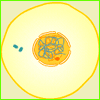
Here is mine: I feel like a cell in telophase. This is when the cell splits in two and separates. It is a phase in the process of cell division (mitosis) that is the end of a growth phase in a cell and signals the creation of 2 separate new cells.
http://www.biology.arizona.edu/cell_bio/tutorials/cell_cycle/mitosis_movie.html
I've spent a great deal of time growing, exploring, and learning wonderful lessons. Now, I feel like I'm going to another level where I am not who I was when I was younger, when I first started teaching, and when I first started learning science. I carry the lessons from my former self into this new life and have identified what I really want to pass on to the next generation. Its the end of something (my former motives) but also the start of something (new hopes and motives). I'm sure I will go through this stage again as I age and learn even more. My word is Telophase.
I can't wait to hear yours!
Monday, June 6, 2011
Cognates? Do you brush your teeth with that?
Cognates are words that are spelled and pronounced similarly in more than one language. For example "evolution" in English and "evolución" in spanish are cognates. Notice how they are spelled almost the same. In this case, they are TRUE cognates because they also share the same meaning.
Here is another pair: "mass" in English and "mas" in Spanish. These are FALSE cognates because mass (Eng.) means the measure of matter within an object, whereas mas (Span.) mean more.
(Note: If you are a HS teacher, you have access to the NGELPS online resource and there are lists of cognates available there)

Here is another pair: "mass" in English and "mas" in Spanish. These are FALSE cognates because mass (Eng.) means the measure of matter within an object, whereas mas (Span.) mean more.
(Note: If you are a HS teacher, you have access to the NGELPS online resource and there are lists of cognates available there)

It's important to address these in your class so that all students can gain insight and make connections. Look up some TRUE and FALSE cognates in your content area that will be valuable for students in the upcoming school year. If you could only share one of each (one true and one false) for your content area...which would it be? Explain your choice.
Dissect a key word:
1. Select a key word from your specific content area.
2. Break it up into roots, prefixes, and suffixes and explain what each part means.
3. Use one or two of those parts (roots, prefixes, and suffixes) in another example.
* Don't forget to list any good websites that you find.
Here is an example below:
a herbivore is
herb- i- -vore
herb= plants vore=eat [greedily]
so now you know that herbaceous has something to do with plants and that detritivore has something to do with eating.
This site has a short list of some root words: http://www.ccarney.org/rootwords/la11rw.html
Here is a list of science root words that is pretty extensive: http://www.studystack.com/flashcard-26876
Your turn...
2. Break it up into roots, prefixes, and suffixes and explain what each part means.
3. Use one or two of those parts (roots, prefixes, and suffixes) in another example.
* Don't forget to list any good websites that you find.
Here is an example below:
a herbivore is
herb- i- -vore
herb= plants vore=eat [greedily]
so now you know that herbaceous has something to do with plants and that detritivore has something to do with eating.
This site has a short list of some root words: http://www.ccarney.org/rootwords/la11rw.html
Here is a list of science root words that is pretty extensive: http://www.studystack.com/flashcard-26876
Your turn...
Subscribe to:
Posts (Atom)